Research Article | | Peer-Reviewed

Adaptation Testing of Durum Wheat (Triticum turgidum ssp. durum) Varieties Under Irrigated Areas of Upper and Middle Awash

Received: 17 March 2025     Accepted: 31 March 2025     Published: 28 April 2025
Views:       Downloads:
Abstract

Durum wheat is one of the industrial crops mainly required for the manufacturing of pasta products; macaroni, spaghetti and semolina. Improved durum wheat varieties suitable for irrigated lowland areas of Ethiopia including Afar and Oromia regions are limited. To overcome this constraint, the recently released 12 durum wheat varieties for rainfed conditions were evaluated across four different locations to confirm their environmental adaptation under irrigation during 2021. Grain yield and yield components, and environmental data were collected and analyzed using R-software. The combined analysis of variance indicated that the varieties differed significantly for all traits except for numbers of kernels per spike. There were highly significant differences among durum wheat varieties in their performances in yield and yield related traits across locations. D2018 (D2018), Toltu and Fetan varieties gave higher grain yield at Werer and Arage (middle Awash) while Denbi, Bullala and Werer1 at Jeju and Merti (upper Awash). Therefore, D2018 could be recommended for middle Awash while Denbi and Bullala for upper Awash areas for large scale cultivation.

Published in International Journal of Genetics and Genomics (Volume 13, Issue 2)
DOI 10.11648/j.ijgg.20251302.11
Page(s) 20-26
Creative Commons

This is an Open Access article, distributed under the terms of the Creative Commons Attribution 4.0 International License (http://creativecommons.org/licenses/by/4.0/), which permits unrestricted use, distribution and reproduction in any medium or format, provided the original work is properly cited.

Copyright

Copyright © The Author(s), 2025. Published by Science Publishing Group

Keywords

Durum Wheat, Lower Awash, Upper Awash, Variety, Yield

1. Introduction
Wheat is one of the most important cereal crops in terms of production and consumption in Ethiopia. Wheat contributes substantially to food security, poverty reduction, raw materials for food industries and employment creation. The national demand for wheat and wheat products is growing faster than for any other food crops, partly due to the high population growth, increased urbanization, and related changing trends in food consumption patterns and preferences. Reported that Ethiopia has irrigable potential of 3.7 million hectares distributed across high rainfall zone (8.1%), low rainfall zone (32.4%) and pastoralist zone (59.5%). The lowland areas include most of the country's potentially irrigable land, which is estimated to be between 1.0 and 4.3 million hectares . Irrigated agriculture is dominated by Afar and Oromia, which account for 45 and 31 percent of the total irrigated land, respectively . This area is endowed fertile with fresh water that can be utilized for wheat production.
Wheat variety development activities for lowland irrigated areas were started with adaptation trials which were conducted from 1969/70 up to 1986/87 at Werer Agricultural Research Center . The two wheat species dominantly grown in Ethiopia are durum wheat (Triticum turgidum ssp. durum) and bread wheat (Triticum aestivum L.). Durum wheat is derived from a tetra-ploid hybrid of the diploid T. monococcum (einkorn) and a diploid wild grass of unknown origin . Durum wheat holds significant economic and agricultural importance in Ethiopia, known for its wide genetic diversity and resilience compared to bread wheat. It is one of the industrial crops; the grain of durum wheat is mainly required for the manufacturing of pasta products; macaroni, spaghetti and semolina .
The variety development activities of durum wheat for the lowland irrigated areas of Ethiopia, is recent and new. As a result, two durum wheat varieties were officially released for irrigated lowland areas of Ethiopia . Despite its huge potential, the average yield of durum wheat in the lowland irrigated areas is low . One the reason for the low yield is due to shortage of improved varieties and suitable agronomic practices . Therefore, this study aims at identifying adaptable and high-yielding durum wheat varieties for lowland irrigated areas of Afar and Oromia regions.
2. Materials and Methods
2.1. Study Areas
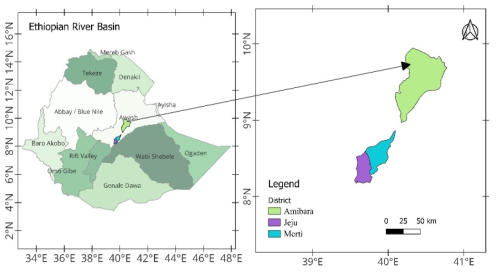
This study was conducted at Werer Agricultural Research Center and Arage farm (Afar regions) and at Merti and Jeju districts (Oromia region) during the 2021/22 cropping season (Figure 1).
Figure 1. Map of the study area.
2.2. Experimental Design and Crop Management
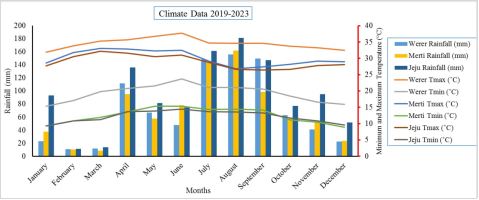
The minimum and maximum temperatures of the experimental sites are presented in Figure 2. Twelve recently released durum wheat varieties for rainfed highland, mid-land and lowland areas were selected for this study (Table 1). The field experiment was laid out in RCBD design with four replications. The total plot area was 15m2 (3m width x 5m length) and two rows per ridge with 30 cm spacing between rows were used. Each plot was planted using a seed rate of 150 kg ha-1. NPS fertilizer was applied at the rate of 100 kg ha-1 at sowing while 150 kg ha-1 Urea was used twice in split application; half at tillering and the remaining at booting stages. Irrigation was applied at every 10 days interval using furrow method. All other agronomic activities were applied according to the recommendations.
Figure 2. Monthly maximum and minimum temperature and Rainfall of the three resting sites.
Table 1. Nationally released durum wheat varieties used in the experiment.

S/N

Variety Name

Genotype Name

Year of release

1

Alemtena

43IDSNMeh 2011-130)

2015

2

Bullalla

Durum ICARDA/Ethiopia PDYT 322

2018

3

Denbi

AJAIA/ BUASHEN

2009

4

Dire

CHEN/E3/BUSHEN4/3/AC089CD SS92B 1ZO Z

2012

5

D2018

D2018

2018

6

Fetan

CDSS02B00643S 0Y-0M-1Y4M-04Y-0B-2Y

2018

7

Mukiye

STJ3 //BCR /LKS4/3/TER-3

2012

8

Toltu

4/B/R9096#21001(980SN Patho)

2010

9

Ude

CD 95294-2Y

2002

10

Utuba

IDON-MD- off/53/2009

2015

11

Werer1

Mamouri 1

2009

12

Yerer

CD 94026-4Y

2002

2.3. Data Collection
Data were collected for days to heading, days to maturity, number of kernels per spike, plant height, thousand seed weight and grain yield.
Days to heading was recorded as number of days from planting to half (50%) of the plants in the plot flower (shade pollen). Days to physiological maturity was recorded as number of days from planting to the date of 90% of the plants reached at physiological maturity (lose their pigmentation and the straw turned yellow). Height of five randomly selected plants was measured from the ground level to the tip of the spike (excluding awns) at physiological maturity and the average expressed as plant height in cm. Spike length was measured in cm from the bottom of the spike to the tip of the spike (excluding the awns) of five randomly selected plants. The following data were collected from five plants randomly selected from the middle four rows of the plot at physiological maturity and the average values of five plants used in analysis. Number of spikelet per spike (NSPS) was recorded on the main tiller. Number of kernels per spike (NKPS) was recorded from each genotype per plot.
Thousand kernel weight (TSW) was recorded as the weight of thousand seeds sampled randomly from the bulk of harvested grain and adjusted to 12.5% moisture content. Grain yield was the weight of grain from a plot adjusted to 12.5% moisture content and converted to kilogram per hectare for analysis.
Statical Analysis
The data were subjected to analysis of variance (ANOVA) using R-software. Combined analysis of variance over location was carried out and Least Significant Difference (LSD) test was used to compare the mean separations at (P<0.05) using Fishery’s least significant difference for comparison test.
3. Results and Discussion
Mean squares analysis of variance for yield and yield related characters of nationally released durum wheat varieties tested across four locations is shown in (Table 2).
The effect of replication within location was not significant for most traits, indicating consistent measurements within each location for traits like days to heading (DH), days to maturity (DM), plant height (PH), spike length (SPL), number of spikelet per spike (NSPS), number of kernels per spike (NKPS), and thousand seed weight (TSW). However, grain yield (GYD) showed a significant effect per replication within location (P<0.01), suggesting that grain yield may be more sensitive to variation within each location and linked with factors such as soil and temperature variation.
Location had a highly significant effect (P< 0.01) on all traits, demonstrating the strong influence of environmental differences among locations on agronomic performance. The effect of variety was also highly significant (p < 0.01) for all traits, which highlights the genetic differences between the varieties in terms of agronomic and yield traits .
The interaction between location and variety was significant for most traits, including DH, DM, NSPS, NKPS, TSW, and GYD (P<0.0 exhibit for PLH and SPL. Hence, significant interaction implies that varieties respond differently per locations. Similarly, reported a significant yield difference among wheat varieties indicating that durum wheat varieties exhibits tremendous genetic variability. This suggested that the magnitude of differences in varieties was adequate to selecting adaptable and high yielding varieties for the lowland irrigated areas.
Table 2. Mean squares analysis of variance for yield and yield related characters of nationally released durum wheat varieties tested across four locations during 2021.

Traits

Source of Variation

Rep/Location df (4)

Location df (3)

Variety df (11)

Location*Variety df (33)

Error df (95)

Mean

R-2

CV%

DH

21.69ns

245.29**

54.61**

18.86**

8.64

59.02

0.84

5.0

DM

2.26ns

236.54**

107.37**

18.81**

3.33

96.80

0.94

2.0

PH (cm)

15.74ns

31793**

50.24**

11.76ns

11.76

75.48

0.76

4.5

SPL (cm)

0.14ns

17.82**

0.79**

0.32ns

0.22

5.15

0.88

9.2

NSPS

1.79ns

58.4**

3.20**

2.1**

0.70

14.20

0.90

5.9

NKPS

11.72ns

1014.19**

70.84**

31.32**

11.89

42.14

0.90

8.2

TSW (gm)

2.6ns

149.8**

75.0**

4.20**

2.00

39.94

0.94

3.40

GYD

425148.83**

13565596.52**

1005599.85**

315149.31**

72190.21

3278.92

0.95

8.20

Note: *, **, indicate significance at the 0.05 and 0.01 probability levels while ns indicate non-significance. LSD = least Significance Difference, DH = Days to heading, DM = days to maturity, PLH = Plant height, SPL = Spike Length, NSPS = number of spikelet per spike, NKSP = number of kernels per spike, TSW = thousand seed weight, GYD = grain yield kg per ha.
Mean Grain Yield performance of Varieties
There was significant difference among Varieties, locations and their interaction on grain yield (Table 3). The yield difference across location may come from the adaptability of varieties in specific area and difference in soil, temperature and other factors of the study areas. Among the tested varieties, D2018 and Toltu (5098.0 and 4705.9 kg ha-1) did perform well at Werer D2018 and Fetan (4266.7 and 4133.4 kg ha-1) at Arage, respectively. Denbi and Werer-1 (3294.2 and 2920.6 kg ha-1) at Jeju and Bullalla and Denbi (4156.9 and 3686.3 kg ha-1) were well performed, respectively .
The performance of durum wheat varieties across the four locations reveals considerable variation in grain yield, reflecting the varieties’ differing responses to environmental conditions . The average grain yield across locations ranged from 2768.9 for variety Utuba to 3827.2 kg ha-1 for Variety D2018 with grand mean 3278.9 Kg ha-1 across the four locations with grand mean 3278.92 Kg ha-1. Among the varieties, D2018 showed the highest mean yield across locations (3827.2 kg ha-1), indicating its adaptability and high yield potential across diverse conditions. Denbi, Bulala and ranked 2nd and 3rd, following D2018 with mean yields of (3713.7, 3673.8 and 3548 kg ha-1), respectively, placing them among the top performers and suggesting that, they also possess good yield across different environments. Found, despite the large E and GEI effects; it is possible to identify adaptable and high yielding genotypes in diverse environments.
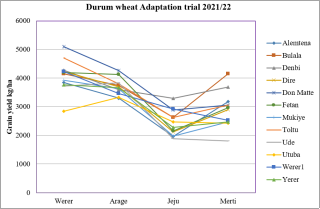
In contrast, Utuba and Ude exhibited the lowest mean yields of 2768.9 kg ha-1 and 2811.3 kg ha-1, respectively, which indicated that these varieties are less adaptable to the environmental factors within the tested locations. The effects of variety by location interactions showing that there were cross-over interaction among the wheat varieties (Figure 3). Found grain yield to be highly influenced by environment and genotype.
The results showed that durum wheat varieties performed well in yield in middle Awash (Werer and Arage) than upper Awash (Merti and Jeju) indicating there is more potential to produce durum wheat in the irrigated dry lowland areas.
Figure 3. Variety by location cross over interaction for grain yield.
Table 3. Performance of varieties over four locations (Werer, Arage, Jeju and Merti).

Variety

Locations

Werer

Arage

Jeju

Merti

Mean

Alemtena

3843.2

3300

1960.8

3176.5

3070.1efg

Bullalla

4156.9

3750

2631.4

4156.9

3673.8ab

Denbi

4274.5

3600

3294.2

3686.3

3713.7ab

Dire

4235.3

3700

2117.7

2902

3238.7def

D2018

5098

4266.7

2885.3

3058.9

3827.2a

Fetan

4196.1

4133.4

2156.9

2969.6

3364.0cd

Mukiye

3921.6

3633.3

1971.6

2470.6

2999.3fgh

Toltu

4705.9

3800

2627.5

3058.8

3548.0bc

Ude

3725.5

3833.3

1882.4

1803.9

2811.3gh

Utuba

2843.2

3333.4

2467.7

2431.4

2768.9h

Werer1

4235.3

3466.7

2920.6

2529.4

3288.0cde

Yerer

3764.7

3666.7

2274.5

2470.6

3044.1efg

Mean

CV

3278.92

8.2

LSD (5%)

270.75

Note: CV = coefficient of Variation. LSD = least Significance Difference, GYD = grain yield kg per ha.
Agronomic Performance
The analysis of variance for agronomic parameters among durum wheat varieties across four locations shows significant differences in days to heading (DH), days to maturity (DM), number of spikelet per spike (NSPS), number of kernels per spike (NKPS), and thousand seed weight (TSW).
Yerer variety had the longest DH (65.1 days) and DM (104.0 days), while Bullala had the shortest DH (55.25 days) and DM (91.6 days); the latter is an early-maturing variety. NSPS varied significantly, with Yerer having the highest mean (15.6) and Ude the lowest (13.2), indicating variability in spikelet production potential across varieties. NKPS, which influences yield, was highest in Dire (47.07 kernels) and lowest in Ude (36.05 kernels), showing a significant range among varieties .
Thousand seed weight, a key yield component, also showed significant differences; varieties such as Donmateo (43.5 gm), Werer-1 (43.0 gm), and Utuba (43.5 g) had high TSW values, indicating a seed weight favorable for quality traits. In contrast, Dire had the lowest TSW (35.0 g), suggesting it may produce smaller seeds relative to other varieties. These significant variations in agronomic traits emphasize the differential adaptation and yield potential of the varieties in diverse environmental conditions, with varieties like Yerer and Utuba shining in specific traits.
Table 4. Combined mean of Agronomic parameters over four locations (Werer, Arage, Jeju and Merti).

Variety

Traits

DH

DM

NSPS

NKPS

TSW

Donmateo (D2018)

59.0b-e

95.5d

14.6bc

42.8bcd

43.5a

Denbi

59.1b-e

94.9d

14.1bcd

41.3cde

37.1c

Bullalla

55.3f

91.6f

13.5de

42.2bcd

39.9b

Toltu

57.4def

95.1d

13.7de

44.7abc

37.7c

Fetan

56.3ef

93.5de

14.3bcd

43.8a-d

37.5c

Werer-1

61.0bc

101.6b

14.0cde

38.3ef

43.0a

Dire

58.4cde

96.1d

14.3bcd

47.1a

35.0d

Almtena

57.3def

95.0d

14.0bcd

44.9ab

36.5c

Yerer

65.1a

104.0a

15.6a

42.3bcd

40.6b

Mukiye

58.8b-e

95.1d

14.0cde

40.4de

42.2a

Ude

59.4bcd

98.0c

13.2e

36.1f

42.7a

Utuba

61.4b

101.1b

14.8ab

42.0bcd

43.5a

Mean

59.02

96.8

14.2

42.14

39.94

CV

5

2

5.9

8.2

3.4

LSD (5%)

3

1.8

0.9

3.5

1.4

Note: *, **, and ns indicate significance at the 0.05 and 0.01 probability levels and non-significance, respectively. LSD = least Significance Difference, DH = Days to heading, DM = days to maturity, PLH = Plant height, SPL = Spike Length, NSPS = number of spikelet per spike, NKSP = number of kernels per spike, TSW = thousand seed weight
4. Conclusion and Recommendations
Shortage of improved durum wheat varieties suitable for the irrigated lowlands of Afar and Oromia regions are among the major constraints to increase and expand production. This study showed highly significant differences among durum wheat varieties for phenological, yield and yield related traits indicating differential performance across locations. D2018 could be recommended for middle Awash while Denbi and Bullala for upper Awash areas for large scale.
Abbreviations

RCBD

Completely Randomized Block Design

BMZ/GIZ

German Federal Ministry for Economic Cooperation and Development

ADAPT

Adaptation Demonstration and Piloting of Wheat Technologies

Acknowledgments
The Authors express their gratitude to the BMZ/GIZ for funding this study through ADAPT wheat project implemented by the International Maize and Wheat Improvement Center (CIMMYT) and Ethiopian Institute of Agricultural Research (EIAR). Grateful acknowledgement is extended to Werer Agricultural Research Center for facilitating different resources including land preparation. The Authors also thank all irrigated wheat breeding team at the Werer Agricultural Research Center for their invaluable contributions to data collection.
Author Contributions
Hailu Mengistu: Conceptualization, Data curation, Formal Analysis, Investigation, Methodology, Project administration, Resources, Software, Supervision, Validation, Visualization, Writing – original draft
Ambesu Tilaye: Data curation, Investigation, Methodology, Supervision, Visualization, Writing – review & editing
Shimelis Alemayehu: Funding acquisition, Investigation, Project administration, Resources, Supervision, Writing – review & editing
Desta Gebre: Data curation, Supervision, Writing – review & editing
Tadiyos Bayisa: Data curation, Visualization, Writing – review & editing
Mihratu Amanuel: Data curation, Supervision, Writing – review & editing
Daniel Muleta: Investigation, Project administration, Resources, Supervision, Writing – review
Ayele Badebo: Conceptualization, Funding acquisition, Investigation, Project administration, Resources, Supervision, Writing – review
Bekele Abeyo: Conceptualization, Funding acquisition, Investigation, Project administration, Resources, Supervision, Writing – review
Geremew Awas: Funding acquisition, Investigation, Project administration, Resources, Supervision, Writing – review
Conflicts of Interest
The authors declare no conflicts of interest.
References
[1] Abate Feyissa Senbeta and Walelign Worku (2023). Ethiopia’s wheat production pathways to self-sufficiency through land area expansion, irrigation advance, and yield gap closure.
[2] Assefa A., Derebe B., Gebrie N., Shibabaw A., Getahun W., Oumer Beshir Oumer., Abebe Worku A. (2023). Grain yield and quality responses of durum wheat (Triticum turgium L. var. durum) to nitrogen and phosphorus rate in Yilmana Densa, Northwestern Ethiopia.
[3] Awulachew S. and Girma M. (2007). Irrigation practices in Ethiopia: Characteristics of selected irrigation schemes. Colombo, Sri Lanka: International Water Management Institute. 80p.
[4] Awulachew, S. and Ayana M. (2011). Performance of irrigation: an assessment at different scales in Ethiopia.
[5] Behailu M., Kassahun T., Mulatu G., Eva J., Teklehaimanot H., Cecilia H., Faris H., Rodomiro Ortiz (2022). Multivariate analyses of Ethiopian durum wheat revealed stable and high yielding genotypes.
[6] Belachew M. and Demse B. (2022). The Current Irrigation Potential and Irrigated Land in Ethiopia-A Review.
[7] Gebre D., Amanuel M., Debele T., Mengistu H., Bayisa T. (2017). Enhancing sustainable wheat productivity and production through development of wheat varieties best adapted to irrigated lowland areas of Ethiopia. International Journal of Agriculture Innovations and Research 6(2): 2319-1473.
[8] Gadisa A., Alemu D., Nagesh G., Ruth D. Tafesse S., Habtemariam Z., Abebe G., Abebe D., Dawit A., Bayisa A., Yewubdar S., Bekele A. and Ayele B. (2021). Genotype × Environment Interaction and Selection of High Yielding Wheat Genotypes for Different Wheat-growing Areas of Ethiopia.
[9] Jamal M. 1994. Performance of wheat genotypes under irrigation in a wash valley, Ethiopia. African Crop Science Journal, 2(2).
[10] Legesse Z., Abduselam F. and Berhanu H. (2019). Performance Evaluation and Adaptability Study of Durum Wheat (Triticum turgidum var. durum) Varieties in Moisture Stress Areas of East Hararghe, Oromia.
[11] Melese L., Selamawit M. and Tariku S. (2024). Evaluation of bread wheat varieties (Triticum aestivum) in selected areas of Gamo District, Southern Ethiopia.
[12] Molla M., Getenet S., Muluken B., Amleku T., Eshetie A., Misganaw F., Desalew F., Sefinew W., Yasin T., Desalegn G., Zelalem A. and Abunu Malefia C.(2020). Participatory variety selection and stability analysis of Durum wheat varieties (Triticumdurum Desf.) in northwest Amhara.
[13] Schmidt, John W (1974) Breeding and genetics. In: Inglett George (Ed.), Wheat Production and Utilization. The AVI Publishing Company, Inc., Westport, CT. pp. 8-30.
[14] Shibeshi S. and Kassa D. (2021). Evaluation of durum wheat varieties for yield and yield related traits in highland areas of southern Ethiopia.
[15] Reza M., Ezatollah F. and Ahmed A. (2015). Interpreting genotype × environment interactions for grain yield of rainfed durum wheat in Iran.
Cite This Article
  • APA Style

    Mengistu, H., Tilaye, A., Alemayehu, S., Gebre, D., Bayisa, T., et al. (2025). Adaptation Testing of Durum Wheat (Triticum turgidum ssp. durum) Varieties Under Irrigated Areas of Upper and Middle Awash. International Journal of Genetics and Genomics, 13(2), 20-26. https://doi.org/10.11648/j.ijgg.20251302.11

    Copy | Download

    ACS Style

    Mengistu, H.; Tilaye, A.; Alemayehu, S.; Gebre, D.; Bayisa, T., et al. Adaptation Testing of Durum Wheat (Triticum turgidum ssp. durum) Varieties Under Irrigated Areas of Upper and Middle Awash. Int. J. Genet. Genomics 2025, 13(2), 20-26. doi: 10.11648/j.ijgg.20251302.11

    Copy | Download

    AMA Style

    Mengistu H, Tilaye A, Alemayehu S, Gebre D, Bayisa T, et al. Adaptation Testing of Durum Wheat (Triticum turgidum ssp. durum) Varieties Under Irrigated Areas of Upper and Middle Awash. Int J Genet Genomics. 2025;13(2):20-26. doi: 10.11648/j.ijgg.20251302.11

    Copy | Download

  • @article{10.11648/j.ijgg.20251302.11,
      author = {Hailu Mengistu and Ambesu Tilaye and Shimelis Alemayehu and Desta Gebre and Tadiyos Bayisa and Mihratu Amanuel and Daniel Muleta and Ayele Badebo and Bekele Abeyo and Geremew Awas},
      title = {Adaptation Testing of Durum Wheat (Triticum turgidum ssp. durum) Varieties Under Irrigated Areas of Upper and Middle Awash
    },
      journal = {International Journal of Genetics and Genomics},
      volume = {13},
      number = {2},
      pages = {20-26},
      doi = {10.11648/j.ijgg.20251302.11},
      url = {https://doi.org/10.11648/j.ijgg.20251302.11},
      eprint = {https://article.sciencepublishinggroup.com/pdf/10.11648.j.ijgg.20251302.11},
      abstract = {Durum wheat is one of the industrial crops mainly required for the manufacturing of pasta products; macaroni, spaghetti and semolina. Improved durum wheat varieties suitable for irrigated lowland areas of Ethiopia including Afar and Oromia regions are limited. To overcome this constraint, the recently released 12 durum wheat varieties for rainfed conditions were evaluated across four different locations to confirm their environmental adaptation under irrigation during 2021. Grain yield and yield components, and environmental data were collected and analyzed using R-software. The combined analysis of variance indicated that the varieties differed significantly for all traits except for numbers of kernels per spike. There were highly significant differences among durum wheat varieties in their performances in yield and yield related traits across locations. D2018 (D2018), Toltu and Fetan varieties gave higher grain yield at Werer and Arage (middle Awash) while Denbi, Bullala and Werer1 at Jeju and Merti (upper Awash). Therefore, D2018 could be recommended for middle Awash while Denbi and Bullala for upper Awash areas for large scale cultivation.
    },
     year = {2025}
    }
    

    Copy | Download

  • TY  - JOUR
    T1  - Adaptation Testing of Durum Wheat (Triticum turgidum ssp. durum) Varieties Under Irrigated Areas of Upper and Middle Awash
    
    AU  - Hailu Mengistu
    AU  - Ambesu Tilaye
    AU  - Shimelis Alemayehu
    AU  - Desta Gebre
    AU  - Tadiyos Bayisa
    AU  - Mihratu Amanuel
    AU  - Daniel Muleta
    AU  - Ayele Badebo
    AU  - Bekele Abeyo
    AU  - Geremew Awas
    Y1  - 2025/04/28
    PY  - 2025
    N1  - https://doi.org/10.11648/j.ijgg.20251302.11
    DO  - 10.11648/j.ijgg.20251302.11
    T2  - International Journal of Genetics and Genomics
    JF  - International Journal of Genetics and Genomics
    JO  - International Journal of Genetics and Genomics
    SP  - 20
    EP  - 26
    PB  - Science Publishing Group
    SN  - 2376-7359
    UR  - https://doi.org/10.11648/j.ijgg.20251302.11
    AB  - Durum wheat is one of the industrial crops mainly required for the manufacturing of pasta products; macaroni, spaghetti and semolina. Improved durum wheat varieties suitable for irrigated lowland areas of Ethiopia including Afar and Oromia regions are limited. To overcome this constraint, the recently released 12 durum wheat varieties for rainfed conditions were evaluated across four different locations to confirm their environmental adaptation under irrigation during 2021. Grain yield and yield components, and environmental data were collected and analyzed using R-software. The combined analysis of variance indicated that the varieties differed significantly for all traits except for numbers of kernels per spike. There were highly significant differences among durum wheat varieties in their performances in yield and yield related traits across locations. D2018 (D2018), Toltu and Fetan varieties gave higher grain yield at Werer and Arage (middle Awash) while Denbi, Bullala and Werer1 at Jeju and Merti (upper Awash). Therefore, D2018 could be recommended for middle Awash while Denbi and Bullala for upper Awash areas for large scale cultivation.
    
    VL  - 13
    IS  - 2
    ER  - 

    Copy | Download

Author Information
  • Werer Agricultural Research Center, Ethiopian Institute of Agricultural Research, Addis Ababa, Ethiopia

  • Werer Agricultural Research Center, Ethiopian Institute of Agricultural Research, Addis Ababa, Ethiopia

  • Werer Agricultural Research Center, Ethiopian Institute of Agricultural Research, Addis Ababa, Ethiopia

  • Werer Agricultural Research Center, Ethiopian Institute of Agricultural Research, Addis Ababa, Ethiopia

  • Werer Agricultural Research Center, Ethiopian Institute of Agricultural Research, Addis Ababa, Ethiopia

  • Werer Agricultural Research Center, Ethiopian Institute of Agricultural Research, Addis Ababa, Ethiopia

  • Werer Agricultural Research Center, Ethiopian Institute of Agricultural Research, Addis Ababa, Ethiopia

  • CIMMYT- Ethiopia Office, ILRI Gurd Sholla Campus, Addis Ababa, Ethiopia

  • CIMMYT- Ethiopia Office, ILRI Gurd Sholla Campus, Addis Ababa, Ethiopia

  • CIMMYT- Ethiopia Office, ILRI Gurd Sholla Campus, Addis Ababa, Ethiopia