Research Article | | Peer-Reviewed

Adaptability Evaluation of Bread Wheat (Tritium aestivum L.) Varieties Under Irrigated Conditions in the Upper and Middle Awash Area

Received: 26 March 2025     Accepted: 11 April 2025     Published: 24 May 2025
Views:       Downloads:
Abstract

Wheat (Triticum spp) is one the most important and strategic cereal crops in Ethiopia, because of its role in food security, import substitution and used as raw material for the agro-processing. Bread wheat is recently cultivated in the lowland irrigated areas of Ethiopia. Despite many improved bread wheat varieties have been released nationally for rainfed areas, the adaptability of these varieties were not identified. To overcome this challenge, adapatabilty evaluation of recently released bread wheat varieties were condudcted to confirm their environmental adaptation across four locations. Systematic growth, yield and yield components, and environmental data were collected and analyzed using standard agronomic and statistical methodologies. The combined analysis of variance indicated that the sixteen tested varieties differed significantly for all traits except for their numbers of kernesl per spike. Variety Boru (4823.5 and 4566.7 kg ha-1), Dursa (4352.9 and 3950 kg ha-1) and Abay (4078.4 and 4433 kg ha-1) stand out as the highest yielders at Werer and Arage respectively, indicating these varaieteis are best adapted and high yielding next to Ga’ambo-2 (chek) (4352.9 and 4388.3 kg ha-1) in Afar region. Varaiety Biftu (3339.2 and 2965.2 kg ha-1), Dursa (2880.4 and 3122.6 kg ha-1) and Deka (2779.4 and 3087.5 kg ha-1) recorded higher gran yield at Jeju and Merti respectively, indicating these varieties were best performing in Oromia region. High combined mean grain yield was recorded from Boru and Dursa variety (3626.22 kgha-1 and 3563.97 kgha-1) following the standard check variety “Gambo-2” (3781.89 kgha-1) suggesting Boru and Dursa could be used as a widely adapted durum wheat variety with high grain yield to enhance wheat cultivation in irrigated lowland of Ethipia. The lowest grain yield was recorded in variety Wane (3006.37 kg ha-1) and Ardi (2368.87 kg ha-1) suggesting, Wane and Ardi may be less adaptable and low yielder.

Published in International Journal of Genetics and Genomics (Volume 13, Issue 2)
DOI 10.11648/j.ijgg.20251302.13
Page(s) 33-41
Creative Commons

This is an Open Access article, distributed under the terms of the Creative Commons Attribution 4.0 International License (http://creativecommons.org/licenses/by/4.0/), which permits unrestricted use, distribution and reproduction in any medium or format, provided the original work is properly cited.

Copyright

Copyright © The Author(s), 2025. Published by Science Publishing Group

Keywords

Bread Wheat, Yield, Adaptability, RCBD, Variety

1. Introduction
Ethiopia, with total area of 2.1 million hectares and total annual production of 6.7 million tons , is the largest wheat producer in SSA followed by South Africa Wheat (Triticum spp) is one the most important and strategic cereal crops in Ethiopia, because of its role in food security, import substitution, used as raw material for agro-processing industry and its leftover used as livestock feed (Wheat shares 14% of the total calorie intake which makes it the second most important food crop behind maize and ahead of teff and ranks third after teff and maize in area coverage . The two wheat species dominantly grown in Ethiopia are durum wheat (Triticum turgidum L. var. durum.) and bread wheat (Tritium aestivum L.). Ethiopia has set a plan to expand irrigated wheat production and expansion as one of the pillar for wheat self-sefficiency by producing 6 Mts of wheat from 1.5 Mha by irrigation alone, which is equivalent to wheat produced in 2021 . Small scale (<200ha) to large-scale (>3000ha) irrigation schemes along the Awash River, Omo, Genale, Wabi-Shebele and other river basins in the lowland araes are suitable for the crop production . The expansion of lowland irrigated wheat areas has been driven by the availability of extensive untapped irrigation land in different parts of the country . Wheat variety development activities for lowland irrigated areas were started with adaptation trials which were conducted from 1969/70 up to 1986/87 at Werer Agricultural Research Center . There are two main approaches in developing, testing, and releasing new wheat varieties. The first is the conventional breeding process, which involves long-term variety development and a formal release procedure. The second is a fast- track approach that accelerates variety development and release . Testing nationally released wheat variety for their adaptability and recommendation of high yielding and heat stress tolerant varieties is also imporatant to enhance wheat production in the lowland areas. In countries such as Egypt illet temperature tolerant varieties could yield more than 10 t ha-1 under optimum irrigation and modern cultivation techniques . In spite of, untapped potential in the lowlands of Ethiopia, alternative wheat varieties having wide adaptabilty, high yielding, disease resistant, heat stresss tolerant with good processing quality is one of the bottlenecks. Despite there are recently released wheat varieties, shortage of improved varieties and a limited study in nationaly released bread wheat variety for their adaptability under lowland irrigated condtion was a problem. Thus, with this objective adaptability evaluation of bread wheat variety trial were conducted in four locations.
2. Materials and Methods
2.1. Study Area
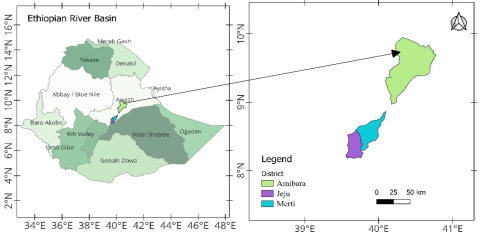
This study was conducted during 2021/22 cropping seasons in Afar Region (Werer Agricultural Research Center and Amibara districts) and Oromia Region Merti and Jeju districts (Figure 1).
Figure 1. Map of study area.
2.2. Experimental Design and Crop Management
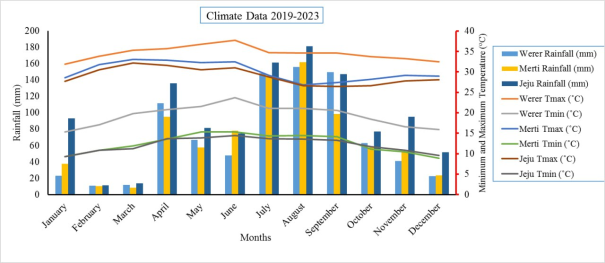
The minimum and maximum temperatures and Average monthly rainfall of the experimental sites are presented on Figure 2. Sixteen Bread wheat Varieties released for highland, Mid-land and lowland areas were selected and used to conduct the experiment (Table 1). The field experiment was laid out in RCBD design with four replications. The total plot area was 15m2 (3m width x 5m length) and two rows per ridge with 30 cm spacing between rows were used. Each plot was planted using a seed rate of 150 kg/ha. NPS fertilizer was applied at the rate of 100 kg ha-1 once at sowing time and 150 kg ha-1 Urea (69N) was applied in split application; half at seedling or tillering stage and the remaining half at booting stages. The trial was raised under irrigation across all the test locations and irrigation water was applied at every 10 days interval using furrow method. All other agronomic activities were applied uniformly for each plot.
Figure 2. Monthly maximum and minimum temperature and Rainfall of the three resting sites.
Table 1. Nationally released disease resistant bread wheat varieties used in the experiment.

S/N

Variety Name

Genotype name

Year of release/registration

1

Abay

ETBW9396

2021

2

Amibara–2

ETBW 5963

2017

3

Ardi

GLADIUS?2*BAVIS

2019

4

Balcha

ETBW8260

2019

5

Biftu

ETBW173528

2022

6

Boru

ETBW9554

2020

7

Danda’a

Danphe#1

2010

8

Deka

ETBW7638

2018

9

Dursa

ETBW9578

2020

10

Fentale-2

QAFZAH-2/FERRIUG-2

2017

11

Ga'ambo-2

HEILO//MILAN/MUNIA/3/KIRITATI/2*TRCH

2019

12

Kakaba

Picaflor # 1

2010

13

Kingbird

-

2015

14

Shaki

ETBW9089

2021

15

Shorima

ETBW 5483

2011

16

WANE

(ETBW 6130)

2016

2.3. Data Collection Procedures
Data was collected at plot level as per descriptor from the traits; days to heading, days to maturity, number of kernels per spike, plant height, thousand seed weight and grain yield.
Days to heading was recorded as number of days from planting to the date on which half (50%) of the plants on the plot flower (shade pollen). Days to physiological maturity was recorded number of days from planting to the date on which 90% of the plants in the plot showed physiological maturity (lose their pigmentation and the straw turned yellow). Height of five randomly selected plants was measured from the ground level to the tip of the spike (excluding awns) at physiological maturity and the average expressed as plant height in cm. Spike length was measured in cm from the bottom of the spike to the tip of the spike (excluding the awns) of five randomly selected plants. The following data were collected from five plants randomly selected from the middle four rows of the plot at physiological maturity and the mean of these five plants was used in analysis. Number of spikelet per spike (NSPS) was recorded as number of spikelet found on each sampled plant; the main tiller was used. Number of kernels per spike (NKPS) was recorded as the total number of seed from five randomly sampled spikes from each variety per plot.
The following data were recorded from the whole plot at harvest. Thousand kernel weight (TSW) was recorded as the weight of thousand seeds sampled randomly from the bulk of harvested grain and adjusted to 12.5% moisture content. Grain yield was the weight of grain from a plot in grams adjusted to 12.5% moisture content and converted to kilogram per hectare for analysis.
2.4. Statical Analysis
All the collected agronomic and growth data were subjected to analysis of variance (ANOVA) using R-software. Combined analysis of variance over location was carried out and Least Significant Difference (LSD) test was used to compare the mean separations at (P< 0.05) using Fishery’s least significant difference for comparison test.
3. Results and Discussion
The combined analysis of variance (ANOVA) reveals significant impacts from replication within location, location, variety, and their interactions on key traits in bread wheat . Replication effects, particularly significant for plant height (PH), spike length (SPL), number of spikelets per spike (NSPS), and grain yield (GYD), highlight how environmental factors within location (Werer, Arage, Jeju, and Merti) shape these traits. The significant variance in PH (p < 0.05) and GYD (p < 0.01) across replications underscores the influence of localized conditions, such as soil and water availability, on wheat growth and productivity within each study location.
Location effects were highly significant (p < 0.01) for all examined traits, including phenological (DH, DM), structural (PH, SPL), reproductive components (NSPS, NKPS, TSW), and grain yield (GYD), suggesting that regional environmental factors, like temperature and other invirometal factors, exert a strong influence on wheat growth and yield potential. This finding supports the need to selected specifi adapted variety and management strategies, as they directly affect wheat’s structural and reproductive development. In particular, the significant effect of location on GYD indicates that regional environmental variations play a crucial role in determining overall productivity .
Variety effects were also found to be highly significant (p < 0.01) across all traits, pointing to the importance of genetic factors or varietal response in wheat performance under lowland enviromets. Differences among varieties in DH and DM indicate genetic variation in phenological responses, while the significance of PLH, SPL, NSPS, NKPS, and TSW highlights genetic variabilty in structural and yield-related traits . The significant variation in GYD across varieties suggests that certain varieties are genetically inclined to produce higher yields, supporting the role of targeted variety selection in maximizing wheat productivity. The significant interaction between location and variety across most traits, including GYD, suggests that the relative performance of varieties is location-dependent. This interaction indicates that certain varieties excel in specific environments, reinforcing the value of site-specific recommendations for variety selection to achieve optimal results . Overall, the ANOVA results suggest that yield and yield components in bread wheat are influenced by both genetic and environmental factors, advocating for breeding programs focused on stable, high-yielding varieties adaptable across various environments.
Table 2. Mean squares analysis of variance for yield and yield related characters of Bread wheat.

Source of Variations

DF

Traits

DH

DM

PLH (cm)

SPL (cm)

NSPS

NKPS

TSW (gm)

GYD (kg/ha)

Rep (Location)

12

7.15ns

5.81ns

50.13**

0.79*

2.29*

18.26ns

6.64*

666540**

Location

3

455.56**

195.33**

363.28**

39.74**

80.80**

544.12**

112.15**

48975746**

Variety

15

180.55**

352.65**

205.33**

3.93**

15.42**

221.32**

110.92**

1559147**

Location *Variety

45

23.50**

17.21**

29.55*

0.52*

1.37**

26.91

6.77**

563926**

Error

180

7.38

4.10

15.24

0.27

1.04

13,25

3.40

191385.7

Mean

53.18

91.24

76.75

7.15

14.54

39.74

37.50

3291.04

R-Square

0.80

0.99

0.71

0.81

0.76

0.72

0.80

0.86

CV%

5.11

2.22

5.09

7.23

7.00

9.16

4.92

13.29

varieties tests across four locations (Werer, Arage, Jeju and Merti).
Note: *, **, and ns indicate significance at the 0.05 and 0.01 probability levels and non-significance, respectively. LSD = least Significance Difference, DH = Days to heading, DM = days to maturity, PLH = Plant height, SPL = Spike Length, NSPS = number of spikelet per spike, NKSP = number of kernels per spike, TSW = thousand seed weight, GYD = grain yield per ha.
3.1. Mean Grain Yield Performance of Varieties
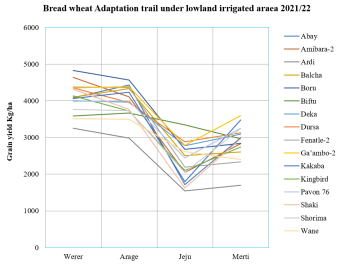
Grain yield was highly significantly (P<0.05) due to varieties as well as interaction between Location and variety (Table 2). The result displayed that there was a significant differences among bread wheat varieteis for grain yield across test locations indicating that there is a possibility to select good performing varieties . (Table 3) highlights the yield performance of various wheat varieties across four locations (Werer, Arage, Jeju, and Merti), presenting both individual variety means and the overall location average. The mean grain yield of the varieties across four locations were 3291.04 kg ha-1 which ranged from 3781.89 to 2368.87 kg ha-1). Variety Boru, Dursa and Abay stand out as the highest yielders (4823.5 and 4566.7 kg ha-1), (4352.9 and 3950 kg ha-1) and (4078.4 and 4433. kg ha-1) at Werer and Arage (Amibera) respectively. This shows that these varaieteis are best adapted and high yielding varieties next to the chek varaiety Ga’ambo-2 yielding (4352.9 and 4388.3 kg/ha) in Middle Awash, Afar region. Similarlly, Biftu (3339.2 and 2965.2 kg ha-1), Dursa (2880.4 and 3122.6 kg ha-1) and Deka (2779.4 and 3087.5 kg ha-1) outperformed at Jeju and Merti respectively. This indicating these varieties are best adapted and high high yielding varieties followed by the chek varaiety Ga’ambo-2 in upper Awash, Oromia region. reported similar findings. The effects of Variety by location interactions showing that there was cross-over interaction among the wheat varieties studied Figure 3. Thus, the results obtained from the present study showed evaluation of varieties across locations is imporatant to identifying and selecting wide as well as stable wheat varieties possessing the required grain yield. found grain yield to be highly influenced by environment and genotype.
According to the four location combined analysis result as indicated in Table 3; The maximum mean grain yield (3781.89 kg ha-1) was recorded for the chek variety Ga’ambo-2, followed by variety Boru (3626.22 kg ha-1) and Dursa (3563.97 kg ha-1). Hence, these varieties are suitable for wide adaptation with high yield. This higher grain yield might be associated with adaptability and the genetic make-up of the varieties, heat tolerance diseases resistant. The lowest grain yield was recorded in variety Wane (3006.37 kg ha-1) and Ardi (2368.87 kg ha-1) suggesting that Wane and Ardi may be less adaptable or optimally suited to the tested locations .
Table 3. Performance of varieties over four locations (Werer, Arage, Jeju and Merti).

Variety

Location

Werer

Arage

Jeju

Merti

Mean

Abay

4078.4

4433.3

1715.7

2990.0

3181.86de

Amibara-2

4637.3

4109.99

2048.0

2833.3

3407.16bcd

Ardi

3254.9

2983.3

1539.2

1698

2368.87f

Balcha

4098

4333.3

2505.9

2602

3384.8bcd

Boru

4823.5

4566.7

2674.0

2835.5

3626.22ab

Biftu

3588.2

3666.7

3339.2

2965.2

3293.14cde

Deka

4000

3966.7

2779.4

3087.5

3391.2b-e

Dursa

4352.9

3950.0

2880.4

3122.6

3563.97abc

Fenatle-2

4372.6

4363.3

2187.3

2333.3

3301.62cde

Ga’ambo-2

4352.9

4388.3

2788.2

3598

3781.89a

Kakaba

4058.8

4233.3

1796.1

3476.5

3416.18bcd

Kingbird

4137.3

3716.7

2098.0

2737.3

3197.8def

Pavon 76

3980.4

4000.0

2441.7

3250.5

3418.14bcd

Shaki

4313.7

3766.7

1623.0

2960.8

3347.30bcd

Shorima

3764.7

3733.3

2046.1

3247.1

3197.79de

Wane

3509.8

3500.0

2613.7

2402

3006.37e

Mean

3291.04

CV

13.29

LSD (5%)

305.20

Note: *, **, and ns indicate significance at the 0.05 and 0.01 probability levels, respectively. LSD = least Significance Difference, and GYD = grain yield per ha
Figure 3. Variety by location cross over interaction for grain yield.
3.2. Agronomic Performance
A combined analysis of variance was carried out for seven traits recorded over the locations (Table 4). There was a highly significant difference among the genotypes for all traits including days to heading, days to maturity, plant height, Spike length, number spikelet per spike, number of seed per spike and 1000 seed weight confirming the presence of genotypic variability for phenological traits and yield components .
Days to heading (DH) varied from 57 to 43 days with the mean of all varieties 58.18. The earliest heading was recorded in 43 days in variety Ardi, which was significantly different from other varieties. As in the present studies, significant differences among varieteis for DH under low land irrigated conditions. Number of days to physiological maturity (DM) ranging from 78 to 97 days with mean of all varieties 91.24 days. The variety Boru, Deka, Biftu, and Ga’ambo-2 had the longest maturity period (97, 96 and 94 days respectively) which were high yielding varieties suggesting relatively slower development increase grain yield, while Ardi and Dursa were the earliest to mature (78 and 89 days), indicating early maturity times, which can be beneficial in regions with shorter growing seasons .
The highest plant height (82.54 cm, 81.85 cm and 79.51 cm) were recorded in variety Boru, Deka and Ga’ambo-2 respectively, suggesting strength in plant structure, which may contribute to favorable light interception. The shorter plant height recorded were 69.74 to 70.04 in varieties Wane and Ardi. Spike lengths varied from 8.1 to 6.2 cm with mean of all varieties 7.15 cm. longest ear length (8.1, 7.79 and 7.58 cm) were recorded in variety Ga’ambo-2, Boru and Shorima respectively, reflecting potential for more spikelet space, which often correlates with higher yield, whereas Ardi (6.2 cm) and Wane (6.35 cm) had the shortest spike lengths, possibly affecting grain production negatively. Number of spikelets per spike varied from 17.85 to 13.8 with mean of all varieties 15.51. Highest spikelets per spike (16.84, 16.12, 15.5 and 15.02)) were formed in variety Boru, Ga’ambo-2 (Check), Deka and Biftu, respectively, which were high yielded varieties. Highest numbers of kernels per spike were formed in variety Boru (44.84), kingbird (44.1), Ga’ambo-2 (43.46), Biftu (43.5), Deka (42.23) and Abay (41.71) and whereas Ardi (31.2) and fentale-2 (35.74) formed the lowest number of kernels per spike. Highest number of spikelet per spike (NSPS) and kernels per spike (NKPS) are crucial indicator for high grain yield. Thousand seed weight (TSW) was highest for Ga'ambo2 (41.72 g), with significant contributions from Fenatle-2 and Shaki, indicating larger seeds that could enhance market value and grain yield. On the lower end, Kingbird had the smallest seed weight (32.74 g), which may suggest a yield drawback in terms of grain volume.
Table 4. Combined mean of Agronomic parameters over four locations (Werer, Arage, Jeju and Merti).

Variety

DH

DM

PLH

SPL

NSPS

NKPS

TSW

Ga'ambo-2

55.5ab

94.13cd

79.51bc

8.1a

16.87ab

43.46ab

41.72a

Boru

56.13ab

97.19a

82.54a

7.79ab

16.37a

44.09a

39.12dc

Dursa

53.06def

89.313g

73.3g

6.94def

13.7fgh

39.25c-f

35.52h

Deka

56.00ab

95.63b

81.85ab

7.39cd

15.5bc

42.23abc

38.11dce

Pavon 76

54.88a-d

92.25ef

75.14gh

6.78f

13.6gh

36.0gh

35.06h

Amibara-2

52.06gf

91.44f

77.89c-f

6.91ef

14.4d-g

39.16c-g

37.15fg

Kakaba

54.69b-e

95.43bc

76.74d-g

7.03def

14.28d-g

40.36b-e

35.1h

Biftu

54.75a-d

93.81d

75.59e-h

7.48bc

15.02bcd

43.40ab

37.8ef

Balcha

52.56f

91.25f

77.8c-f

6.99ef

14.08efg

38.59d-h

35.22h

Fenatle-2

50.00h

86.56h

78.46cd

7.4cd

14.4d-g

35.74h

41.44 a

Abay

53.31c-f

90.87f

78.26cde

7.25cde

14.22d-g

41.71a-d

38.66cde

Shorima

56.63a

95.5bc

78.61cd

7.58bc

14.5def

36.05gfh

35.93gh

Kingbird

55.13abc

92.87de

77.05c-g

6.86f

14.87cde

44.10a

32.74i

Shaki

52.81ef

87.75h

75.43fgh

7.4cd

14.4d-g

37.80e-h

40.93ab

Wane

50.5gh

87.75h

69.74i

6.35g

13.9fgh

40.83b-e

35.73h

Ardi

42.94i

78.12i

70.04i

6.2g

13.05h

31.2h

39.77bc

Mean

53.18

91.24

76.75

7.15

14.54

39.61

37.5

CV

5.11

2.2

5.09

8.53

7.0

9.16

4.92

LSD (5%)

1.89

1.41

2.72

0.36

0.71

2.54

1.29

Note: *, **, and ns indicate significance at the 0.05 and 0.01 probability levels and non-significance, respectively. LSD = least Significance Difference, DH = Days to heading, DM = days to maturity, PLH = Plant height, SPL = Spike Length, NSPS = number of spikelets per spike, NKSP = number of kernels per spike, TSW = thousand seed weight
4. Conclusion and Recommendations
The results of the present study showed highly significant differences among durum wheat varieties for phenological, yield and yield related triats indicating differential performance of varieties over the four locations. Both the effect of varaiety and combined analysis showed highly significant differences among the tested varieteis. The effects of L x G interactions that there was high genetic variability among the wheat varieteis studied. This clearly showed that the varieteies were much more influenced by the environmental factors (soil type, soil fertility and temperatures, etc.). This suggests the importance of the assessment of varieties under different locations, in order to identify better performing varieties for a particular location and across location. From the results of this study, it can be concluded that Boru, Dursa and Abay perform better at Werer and Arage (Amibera) indicating these varaieteis are adapted and high yielding varieties next to Ga’ambo-2 (chek) for middle Awash. Variety Biftu, Dursa and Dekaa outperformed at Jeju and Merti, indicating these varieties are best adapted and high high yielding varieties followed by the chek varaiety Ga’ambo-2 for upper Awash. High combined mean grain yield was recorded from Boru and Dursa variety following the standard check variety Gambo-2 indicating these varieties can perform for both middle and upper Awash.
Abbreviations

RCBD

Completely Randomized Block Design

BMZ/GIZ

Germen Federal Ministry for Economic Coopration and Development

ADAPT

Adapttation, Demostration and pioliting of Wheat Technologies

Acknowledgments
Authors sincerely appreciate the CIMMYT, ADAPT-Wheat Project and BMZ for its strong financial and technical supports as well as capacity building for strengthening the lowland irrigated wheat research and development works currently implemented in Ethiopia.
Author Contributions
Hailu Mengistu: Conceptualization, Data curation, Formal Analysis, Investigation, Methodology, Project administration, Resources, Software, Supervision, Validation, Visualization, Writing – original draft
Ambesu Tilaye: Data curation, Investigation, Methodology, Supervision, Visualization, Writing – review & editing
Shimelis Alemayehu: Investigation, Project administration, Resources, Supervision, Validation, Writing – review & editing
Desta Gebre: Data curation, Supervision, Writing – review & editing
Daniel Muleta: Investigation, Project administration, Resources, Supervision, Writing – review & editing
Tadiyos Bayisa: Data curation, Visualization, Writing – review & editing
Mihratu Amanuel: Data curation, Supervision, Writing – review & editing
Ayele Badebo: Conceptualization, Funding acquisition, Investigation, Project administration, Resources, Supervision, Writing – review
Bekele Abeyo: Conceptualization, Funding acquisition, Investigation, Project administration, Resources, Supervision, Writing – review
Geremew Awas: Funding acquisition, Investigation, Project administration, Resources, Supervision, Writing – review
Conflicts of Interest
The authors declare no conflicts of interest.
References
[1] Abate Feyissa Senbeta and Walelign Worku (2023). Ethiopia’s wheat production pathways to self-sufficiency through land area expansion, irrigation advance, and yield gap closure.
[2] Abdul Q., Berhanu L., and Amare G. (2020). Evaluation of wheat genotypes (Triticum aestivum L.) for yield and yield characteristics under low land area at Arba Minch, Southern Ethiopia.
[3] Alemu D., Gadisa A., Berhanu S., Negash G., Abebe D., Tafesse S., Habtemariam Z., Dawit A., Bayisa A., Ruth D., Yewubdar Sh., Abebe G., Demeke Z., Bedada G., Ayele B. and Bekele A. (2023). Biplot for Grain Yield of Bread Wheat (Triticum aestivum) Genotypes under Low Moisture Stress Areas of Ethiopia.
[4] Bayisa T., Habte E., Amanuel M. (2019). Evaluation of bread wheat (Triticum aestivum L.) for potential and related traits under high temperature stress conditions at middle Awash, Ethiopia. Advances in Crop Science and Technology 7: 410.
[5] Effa, K., Fana, D. M., Nigussie, M., Geleti, D., Abebe, N., Dechassa, N., Anchala, C., Gemechu, G., Bogale, T., Girma, D., & Berisso, F. E. (2023). The irrigated wheat initiative of Ethiopia: a new paradigm emulating Asia’s green revolution in Africa.
[6] ESS (2021/22). Ethiopian statistics service. Farm management practices (private peasant holdings, meher season).
[7] Gadisa A., Alemu D., Negash G., Tafesse S., Abebe D., Rut D., Habtemariam Z., Dawit A., Abebe G., Bayisa A., Demeke Z., Bekele G., Ayele B., and Bedada G. (2020). Development of Bread Wheat (Triticum aestivum L.) Varieties for High Moisture areas of Ethiopia: A G x E Interaction and Stability Analysis for Grain Yield.
[8] Gebre D., Amanuel M., Debele T., Mengistu H., Bayisa T. (2017). Enhancing sustainable wheat productivity and production through development of wheat varieties best adapted to irrigated lowland areas of Ethiopia. International Journal of Agriculture Innovations and Research 6(2): 2319-1473.
[9] Gedifew G., Mulugeta B., Desta A., Tesfaye G., Desalegn W. (2020). Adaptation and Performance Evaluation of Bread Wheat (Triticumaestivum L.) Varieties in Guagusa-shikudad District of North western Ethiopia.
[10] Geleta N. and Wakgari R. (2019). Adaptation Study of Released Bread Wheat (Triticum aestivum L) Varieties in the Western Oromia, Ethiopia.
[11] Girma D. and Esuyawkal D. (2020). Evaluation of Lowland Released Bread Wheat (Triticum aestivum L.) Varieties under Irrigation in Raya Valley Southern Tigray, Ethiopia. Vol. 7, Issue 3, pp: (9-14), Available at:
[12] Jamal M. 1994. Performance of wheat genotypes under irrigation in a wash valley, Ethiopia. African Crop Science Journal, 2(2).
[13] Kishk Abdelmageed, CHANG Xu-hong1, WANG De-mei, WANG Yan-jie, YANG Yu-shuang1, ZHAO Guang-cai, and TAO Zhi-qiang (2019). Evolution of varieties and development of production technology in Egypt wheat: A review.
[14] Mihratu A., Desta G. and Tolessa D. (2017). Performance of bread wheat genotypes under different environment in lowland irrigated areas of Afar Region, Ethiopia.
[15] Minot N., Warner J., Lemma S., Kasa L., Gashaw A., Rashid S. (2019). The wheat supply chain in Ethiopia: Patterns, trends, and policy options. Gates Open Res, (2019): 3(174): 174.
[16] Tolessa Debele, Tekeste Kifle, Tesfaye Geleta, Bekele Gemechu, Karta Kaske, Shitaye Homma (2024). A book on National Wheat Seed Roadmap for Ethiopia, Ethiopian Institute of Agricultural Research, Addis Ababa, Ethiopia.
[17] Wuletaw T., Habte Z., Tolesa D., Daniel K., Wondwosen Sh., Tafesse S., Tamrat N., Negash G., Zewdie B. and Solomon A. (2022). Wheat Production and Breeding in Ethiopia: Retrospect and Prospects.
Cite This Article
  • APA Style

    Mengistu, H., Tilaye, A., Alemayehu, S., Gebre, D., Bayisa, T., et al. (2025). Adaptability Evaluation of Bread Wheat (Tritium aestivum L.) Varieties Under Irrigated Conditions in the Upper and Middle Awash Area. International Journal of Genetics and Genomics, 13(2), 33-41. https://doi.org/10.11648/j.ijgg.20251302.13

    Copy | Download

    ACS Style

    Mengistu, H.; Tilaye, A.; Alemayehu, S.; Gebre, D.; Bayisa, T., et al. Adaptability Evaluation of Bread Wheat (Tritium aestivum L.) Varieties Under Irrigated Conditions in the Upper and Middle Awash Area. Int. J. Genet. Genomics 2025, 13(2), 33-41. doi: 10.11648/j.ijgg.20251302.13

    Copy | Download

    AMA Style

    Mengistu H, Tilaye A, Alemayehu S, Gebre D, Bayisa T, et al. Adaptability Evaluation of Bread Wheat (Tritium aestivum L.) Varieties Under Irrigated Conditions in the Upper and Middle Awash Area. Int J Genet Genomics. 2025;13(2):33-41. doi: 10.11648/j.ijgg.20251302.13

    Copy | Download

  • @article{10.11648/j.ijgg.20251302.13,
      author = {Hailu Mengistu and Ambesu Tilaye and Shimelis Alemayehu and Desta Gebre and Tadiyos Bayisa and Mihratu Amanuel and Daniel Muleta and Esayas Shonga and Bekele Abeyo and Geremew Awas and Ayele Badebo},
      title = {Adaptability Evaluation of Bread Wheat (Tritium aestivum L.) Varieties Under Irrigated Conditions in the Upper and Middle Awash Area
    },
      journal = {International Journal of Genetics and Genomics},
      volume = {13},
      number = {2},
      pages = {33-41},
      doi = {10.11648/j.ijgg.20251302.13},
      url = {https://doi.org/10.11648/j.ijgg.20251302.13},
      eprint = {https://article.sciencepublishinggroup.com/pdf/10.11648.j.ijgg.20251302.13},
      abstract = {Wheat (Triticum spp) is one the most important and strategic cereal crops in Ethiopia, because of its role in food security, import substitution and used as raw material for the agro-processing. Bread wheat is recently cultivated in the lowland irrigated areas of Ethiopia. Despite many improved bread wheat varieties have been released nationally for rainfed areas, the adaptability of these varieties were not identified. To overcome this challenge, adapatabilty evaluation of recently released bread wheat varieties were condudcted to confirm their environmental adaptation across four locations. Systematic growth, yield and yield components, and environmental data were collected and analyzed using standard agronomic and statistical methodologies. The combined analysis of variance indicated that the sixteen tested varieties differed significantly for all traits except for their numbers of kernesl per spike. Variety Boru (4823.5 and 4566.7 kg ha-1), Dursa (4352.9 and 3950 kg ha-1) and Abay (4078.4 and 4433 kg ha-1) stand out as the highest yielders at Werer and Arage respectively, indicating these varaieteis are best adapted and high yielding next to Ga’ambo-2 (chek) (4352.9 and 4388.3 kg ha-1) in Afar region. Varaiety Biftu (3339.2 and 2965.2 kg ha-1), Dursa (2880.4 and 3122.6 kg ha-1) and Deka (2779.4 and 3087.5 kg ha-1) recorded higher gran yield at Jeju and Merti respectively, indicating these varieties were best performing in Oromia region. High combined mean grain yield was recorded from Boru and Dursa variety (3626.22 kgha-1 and 3563.97 kgha-1) following the standard check variety “Gambo-2” (3781.89 kgha-1) suggesting Boru and Dursa could be used as a widely adapted durum wheat variety with high grain yield to enhance wheat cultivation in irrigated lowland of Ethipia. The lowest grain yield was recorded in variety Wane (3006.37 kg ha-1) and Ardi (2368.87 kg ha-1) suggesting, Wane and Ardi may be less adaptable and low yielder.
    },
     year = {2025}
    }
    

    Copy | Download

  • TY  - JOUR
    T1  - Adaptability Evaluation of Bread Wheat (Tritium aestivum L.) Varieties Under Irrigated Conditions in the Upper and Middle Awash Area
    
    AU  - Hailu Mengistu
    AU  - Ambesu Tilaye
    AU  - Shimelis Alemayehu
    AU  - Desta Gebre
    AU  - Tadiyos Bayisa
    AU  - Mihratu Amanuel
    AU  - Daniel Muleta
    AU  - Esayas Shonga
    AU  - Bekele Abeyo
    AU  - Geremew Awas
    AU  - Ayele Badebo
    Y1  - 2025/05/24
    PY  - 2025
    N1  - https://doi.org/10.11648/j.ijgg.20251302.13
    DO  - 10.11648/j.ijgg.20251302.13
    T2  - International Journal of Genetics and Genomics
    JF  - International Journal of Genetics and Genomics
    JO  - International Journal of Genetics and Genomics
    SP  - 33
    EP  - 41
    PB  - Science Publishing Group
    SN  - 2376-7359
    UR  - https://doi.org/10.11648/j.ijgg.20251302.13
    AB  - Wheat (Triticum spp) is one the most important and strategic cereal crops in Ethiopia, because of its role in food security, import substitution and used as raw material for the agro-processing. Bread wheat is recently cultivated in the lowland irrigated areas of Ethiopia. Despite many improved bread wheat varieties have been released nationally for rainfed areas, the adaptability of these varieties were not identified. To overcome this challenge, adapatabilty evaluation of recently released bread wheat varieties were condudcted to confirm their environmental adaptation across four locations. Systematic growth, yield and yield components, and environmental data were collected and analyzed using standard agronomic and statistical methodologies. The combined analysis of variance indicated that the sixteen tested varieties differed significantly for all traits except for their numbers of kernesl per spike. Variety Boru (4823.5 and 4566.7 kg ha-1), Dursa (4352.9 and 3950 kg ha-1) and Abay (4078.4 and 4433 kg ha-1) stand out as the highest yielders at Werer and Arage respectively, indicating these varaieteis are best adapted and high yielding next to Ga’ambo-2 (chek) (4352.9 and 4388.3 kg ha-1) in Afar region. Varaiety Biftu (3339.2 and 2965.2 kg ha-1), Dursa (2880.4 and 3122.6 kg ha-1) and Deka (2779.4 and 3087.5 kg ha-1) recorded higher gran yield at Jeju and Merti respectively, indicating these varieties were best performing in Oromia region. High combined mean grain yield was recorded from Boru and Dursa variety (3626.22 kgha-1 and 3563.97 kgha-1) following the standard check variety “Gambo-2” (3781.89 kgha-1) suggesting Boru and Dursa could be used as a widely adapted durum wheat variety with high grain yield to enhance wheat cultivation in irrigated lowland of Ethipia. The lowest grain yield was recorded in variety Wane (3006.37 kg ha-1) and Ardi (2368.87 kg ha-1) suggesting, Wane and Ardi may be less adaptable and low yielder.
    
    VL  - 13
    IS  - 2
    ER  - 

    Copy | Download

Author Information
  • Werer Agricultural Research Center, Ethiopian Institute of Agricultural Research, Addis Ababa, Ethiopia

    Research Fields: Plant Breeding, Genetics and Seed Science and Technology

  • Werer Agricultural Research Center, Ethiopian Institute of Agricultural Research, Addis Ababa, Ethiopia

    Research Fields: Plant Breeding and Genetics

  • Werer Agricultural Research Center, Ethiopian Institute of Agricultural Research, Addis Ababa, Ethiopia

    Research Fields: Plant Breeding and Genetics and Agronomy

  • Werer Agricultural Research Center, Ethiopian Institute of Agricultural Research, Addis Ababa, Ethiopia

  • Werer Agricultural Research Center, Ethiopian Institute of Agricultural Research, Addis Ababa, Ethiopia

    Research Fields: Plant Breeding and Genetics

  • Werer Agricultural Research Center, Ethiopian Institute of Agricultural Research, Addis Ababa, Ethiopia

  • Werer Agricultural Research Center, Ethiopian Institute of Agricultural Research, Addis Ababa, Ethiopia

    Research Fields: soil Science, Microbiology, Land and Water Resources Management

  • Werer Agricultural Research Center, Ethiopian Institute of Agricultural Research, Addis Ababa, Ethiopia

  • CIMMYT- Ethiopia Office, ILRI Gurd Sholla Campus, Addis Ababa, Ethiopia

  • CIMMYT- Ethiopia Office, ILRI Gurd Sholla Campus, Addis Ababa, Ethiopia

  • CIMMYT- Ethiopia Office, ILRI Gurd Sholla Campus, Addis Ababa, Ethiopia